Gamma liquidity management and pauses in swap fee earnings
Updated
Gamma liquidity management automates range adjustments, yet a position stops earning swap fees when market price leaves its active range. A flat earnings display can also reflect little trading or a difference between accrued fees and collected fees. The distinction matters before changing a deposit: moving assets cannot resolve a reporting mismatch. Compare the selected vault's deployed ranges with its pool price, then examine trading and fee accounting over the same interval. Where a vault holds several positions, one inactive range does not establish that the entire vault has stopped earning. Rebalancing follows the strategy's conditions, so automation alone does not establish when earnings will resume.
Inactive ranges and quiet trading can both explain flat fees
A fee pause can begin with a range becoming inactive or with insufficient trading to produce a visible increase. These conditions need different evidence.
Price outside the deployed range
A concentrated liquidity position earns no swap fees while its liquidity is outside the active price range. That condition applies to the individual position. The vault may hold other positions with different boundaries. Pool activity alone therefore cannot establish whether the vault participated in those swaps.
Little trading through active liquidity
Being in range makes liquidity available for swaps; trading produces the fees. A quiet pool can leave an active position with little additional income. Its share also depends on the competing liquidity active during each trade. Total exchange volume does not describe the activity of the specific pool containing the position.
Strategy triggers govern the next range adjustment
Gamma's strategies use different conditions for repositioning liquidity, so a price movement does not imply that every vault should immediately adjust its ranges.
Dynamic range triggers
Gamma's dynamic range strategies trigger rebalances when configured price movements meet their thresholds. Narrower ranges concentrate liquidity more tightly, while wider ranges cover a larger price interval. During prolonged volatility, additional fees from narrow ranges may fail to offset greater divergence costs. More frequent repositioning does not establish better performance.
Pegged price targets
Pegged price strategies position liquidity around an asset's net asset value and rebalance when that value reaches specified targets. Market price can diverge from that reference and leave the position outside its earning range. This differs from a strategy that follows ordinary market price movements. A diagnostic assessment must use the selected strategy's trigger.
Several positions require a vault-wide view
Gamma supports both dual-position strategies and strategies that distribute liquidity across more positions. A single range label may describe only part of the deployment.
The classic dual-position design uses a base position and a limit position. Their boundaries and liquidity amounts matter separately. Seeing one position outside its range does not reveal whether another position remains active or how much capital it represents.
Strategies with multiple positions require the same distinction across their deployed distribution. Counting active ranges gives an incomplete picture because those ranges need not contain equal liquidity. A small active allocation and a large active allocation can produce different fee income under otherwise comparable conditions.
Token balances describe exposure rather than fee activity
A changing token mix reflects how the pool exchanges assets as price moves. It does not independently show whether the vault earned fees during that movement.
At a range boundary, an individual concentrated liquidity position can consist entirely of one token. Other positions and idle balances can leave the overall vault holding both tokens. Likewise, a flat vault-share balance does not mean its underlying assets stayed unchanged. Deposit ratios and withdrawal composition follow the vault's holdings; the original contribution does not remain a fixed inventory that rebalancing restores.
Accrual, collection and compounding produce different records
Fees can accumulate before a manager collects and reinvests them, so a collection total does not necessarily measure everything earned since its previous update. On Uniswap v3, the underlying position tracks accrued fees separately from deployed liquidity. Gamma performs management operations on behalf of its vault depositors.
Gamma's dual-position strategies regularly compound accrued fees back into their positions. A compounding event therefore describes the handling of existing earnings. It does not prove that every range currently earns new fees. Depending on the vault implementation, transaction records can distinguish rebalancing from fee processing. Their interpretation must match the contract that emitted them.
Tracing a flat fee display before moving assets
Consider a vault whose displayed swap fees remain unchanged when you expect further earnings. Begin with read-only checks and keep the comparison interval consistent. The sequence below investigates the mismatch without changing the deposit. It describes a diagnostic procedure, not an automatic recovery process.
| Diagnostic stage | Read-only action | Evidence to retain | Required context |
|---|---|---|---|
| Identify the position | Match the vault and underlying pool to the deposit. | Network, contract identity and deposit record. | The actual vault used for the contribution. |
| Establish range activity | Compare pool price with every deployed range. | Range boundaries, liquidity amounts and observation time. | Consistent token order and price units. |
| Check the earning opportunity | Examine pool swaps during the selected interval. | Trading activity while the relevant liquidity was active. | The same pool and time interval. |
| Reconcile fee records | Compare accrual, collection and management events. | Which quantities changed and when. | The displayed metric's definition and contract accounting. |
| Confirm the explanation | Cross-check the result against contract data or transaction records. | A supported cause or a precisely bounded discrepancy. | Matching observations before any asset-changing action. |
If price remained outside every deployed range throughout the selected interval, the lack of new swap fees during that interval matches the range mechanism. Further observation can establish whether price returns or management changes the allocation. Neither event has a universal waiting period. A later range reading establishes activity only at that observation, not throughout the preceding interval.
The displayed figure may remain flat even when swaps generate fees for an active position. If contract accounting shows additional fees, investigate the display rather than redepositing. If the records remain inconsistent, stop before changing assets and raise the discrepancy with the vault's support channel. Public transaction details are sufficient for describing this issue; wallet recovery secrets are unnecessary.
Ticks and accounting intervals sharpen the diagnosis
A tick identifies a price boundary within a concentrated liquidity pool. Comparing the pool's active tick with position boundaries avoids ambiguity from rounded prices on a chart. Token order and decimal precision still matter when converting those boundaries into readable prices. Reversing a price quotation also reverses how its upper and lower bounds appear.
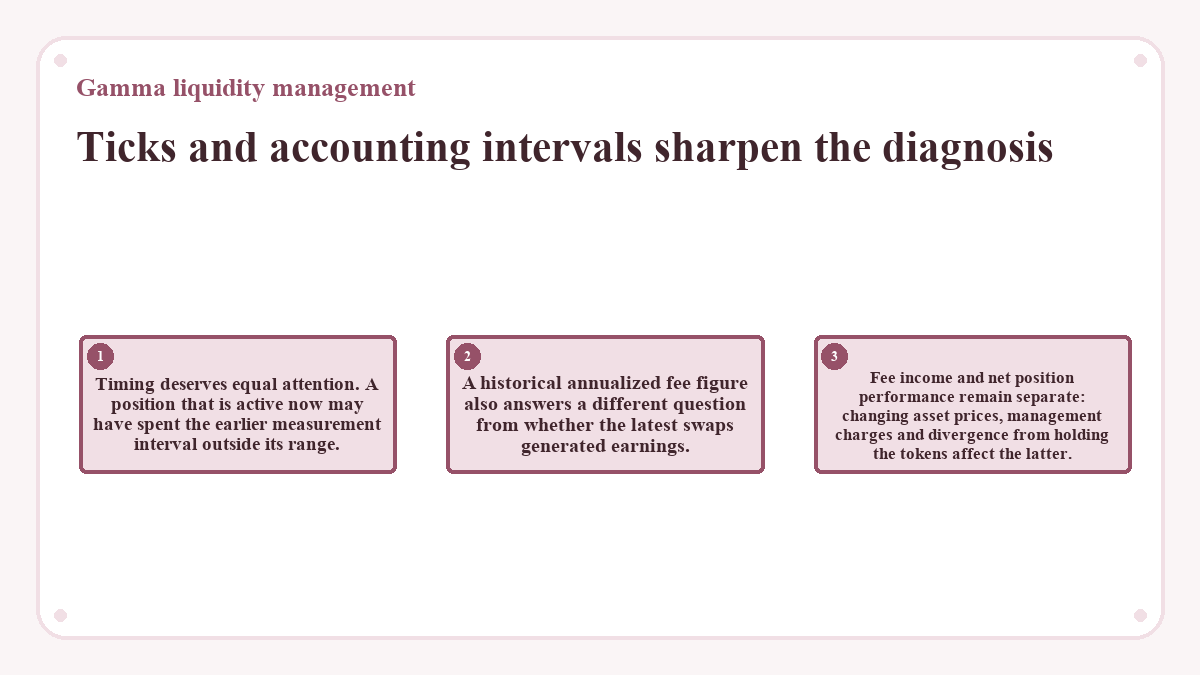
Timing deserves equal attention. A position that is active now may have spent the earlier measurement interval outside its range. A historical annualized fee figure also answers a different question from whether the latest swaps generated earnings. Fee income and net position performance remain separate: changing asset prices, management charges and divergence from holding the tokens affect the latter.
Confirming fee activity before choosing an alternative
Before changing the deposit, confirm the vault identity, account for every deployed range and match the fee records to the trading interval. Establish whether those records explain the pause or leave a display discrepancy unresolved. For inactive ranges, check whether price returns or management changes the allocation; for inconsistent accounting, ask support to inspect the records.
Leaving the position unchanged avoids a new transaction while the explanation remains unresolved, although market exposure continues. Withdrawing changes that exposure and returns the applicable share of current holdings. Compared with a read-only investigation, it is a consequential action that cannot establish why an earlier fee display stayed flat.
What to know about Gamma liquidity management
Does an expired incentive program stop a Gamma vault's swap fees?
An incentive program ending does not itself stop the underlying position from earning swap fees. Those earnings continue when the vault supplies active liquidity to fee-generating swaps. An expired reward program can reduce a combined earnings figure, so distinguish the incentive component from the trading-fee component.
Can closing my browser interrupt automated fee generation?
Closing your browser does not remove liquidity that a completed deposit placed in a Gamma vault. The vault and pool operate through contracts, with Gamma managing the strategy. Reopening the interface changes your view of the position; it does not reactivate its range or generate a missing swap.
Will adding more funds restore earnings to an inactive range?
Adding funds does not by itself make an out-of-range position active. A deposit changes participation in the vault and must meet its applicable requirements. Whether additional assets earn swap fees depends on their deployment, the pool price and subsequent trading. A larger deposit does not resolve the original diagnosis.
Could another pool for the same tokens explain a misleading volume comparison?
Another pool can trade the same tokens without sending any fees to your vault's pool. Different pools have separate liquidity and transaction histories. A pair-wide volume figure therefore cannot prove that the specific position had fee-generating activity. The pool identity must match the vault's deployment.
Are previously earned fees erased when price leaves a range?
Leaving a range stops new swap-fee accrual for that position without inherently cancelling previously accrued fees. Those fees may remain in position accounting or may already have been collected and compounded. Token prices can change the value of those earnings without cancelling their accrual. Once compounded, the earnings become part of the position and share its changing token composition.