Gamma automates liquidity management and supports distinct trading strategies
Updated
Gamma manages concentrated liquidity through automated vaults and supports limit orders and perpetual trading strategies on decentralized exchanges. Liquidity providers delegate range management, while traders use products with different execution rules. Each path changes the assets or exposure held, so its mechanics determine the relevant costs and risks.
Deposits turn pool assets into vault shares
An LP vault accepts the assets that its pool requires and records the depositor's participation through vault shares. LP means liquidity provider: someone who supplies assets that other people trade against. Depositing requires compatible tokens on the vault's network, sufficient transaction fees and the applicable token permissions. Connecting a wallet alone does not create a liquidity position.
The required asset ratio follows the selected vault's holdings and deposit rules. Equal values of both tokens are not a universal requirement. A successful deposit produces an onchain transaction record and a corresponding LP position. Those records distinguish a completed deposit from a token approval, which only authorizes spending.
Pool trading can change the underlying token mix while the share balance stays unchanged. The shares represent participation in changing holdings, rather than a promise to return the original token quantities. Review the proposed deposit before signing its transaction. After execution, recovering assets requires a withdrawal under the vault's rules.
Which Gamma product matches the intended position?
LP vaults suit ongoing liquidity provision, limit orders target a conversion price and perpetual vaults delegate a trading strategy. These products have different completion conditions. A liquidity deposit creates shares; an order awaits execution; a perpetual vault maintains trading exposure. Someone who needs immediate conversion may prefer an ordinary swap. Someone who wants exact control over liquidity boundaries may prefer managing a position directly. Neither preference establishes that the alternative will produce better returns.
Range selection and automated rebalancing
Concentrated liquidity operates within selected price boundaries, so range placement determines where deposited capital can participate in trades. Gamma evaluates rebalance logic offchain and executes the resulting changes onchain. Triggers depend on prices or asset allocations, rather than a universal clock-based schedule.
Dynamic ranges and asset allocation
Dynamic strategies adjust their ranges when configured triggers occur. Narrower ranges concentrate liquidity more heavily and can collect fees efficiently while trading remains nearby. Greater volatility changes that trade-off: divergence losses can outweigh additional fees. Rebalancing also does not require an equal-value allocation between the assets. The strategy manages a liquidity position whose composition follows trading and its chosen boundaries.
Stable and pegged-asset strategies
Stable strategies place liquidity around the relationship between assets that are expected to remain close in value. Pegged-price strategies can instead follow an asset's net asset value. That reference value and the actual market price may diverge. A position centered on the reference can therefore stop earning trading fees when market trading moves outside its range.
Liquidity distributions in Uniswap v4
Gamma's Uniswap v4 strategies spread liquidity across multiple positions using different distribution shapes. Uniform allocation spreads liquidity evenly across a range. Gaussian, triangular and exponential shapes place more around the central price, with different tapers toward the edges. An order-book-shaped distribution places concentrations on either side. These shapes change where capital participates in trading. A distribution with little liquidity near the market price can earn fewer fees, even while other parts of its overall range remain available.
What happens when the market leaves a liquidity range?
A liquidity position stops earning swap fees when trading moves outside its active range, until trading returns or its placement changes. Its asset composition also shifts as the price traverses the range. The position can become concentrated in one underlying asset. Automated management changes placement according to the strategy; it does not preserve the deposit's original purchasing power.
Impermanent loss describes underperformance against holding the deposited assets separately. Trading fees can offset that difference, but their presence does not establish a positive overall return. Narrow ranges intensify exposure to price movement. Wider ranges spread capital across more prices and change the balance between concentration and coverage.
Limit orders on Uniswap v4
The limit-order system uses liquidity positions and swap hooks to support price-based execution on compatible Uniswap v4 pools. A hook is contract logic that runs at defined points around pool operations.
Single-tick orders concentrate liquidity at a specified price interval. Scale orders distribute orders across a price range. The latter expresses a series of execution levels rather than one target.
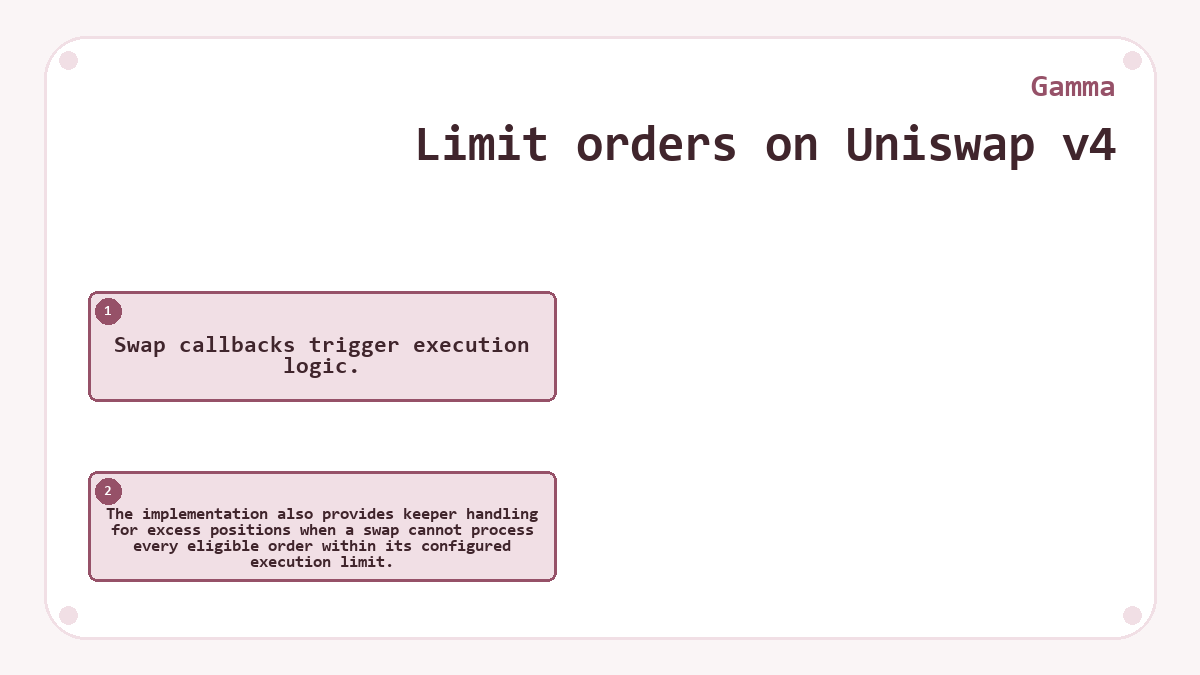
Swap callbacks trigger execution logic. The implementation also provides keeper handling for excess positions when a swap cannot process every eligible order within its configured execution limit.
Order creation, execution and claiming are separate states. Cancellation applies according to the position's state; it cannot reverse a conversion that has already executed. An order record alone therefore does not establish that proceeds have reached the wallet.
Minimum amounts and execution limits depend on contract configuration. These constraints affect acceptance and processing, so there is no universal amount or completion time that applies to every order.
Perpetual vaults and trading signals
Gamma's perpetual vaults use Hyperliquid infrastructure to manage trading positions based on financial signals, momentum or sentiment. Their returns come from trading exposure rather than the liquidity-fee mechanism of LP vaults.
Balanced long and short exposure
Balanced strategies combine long and short positions to reduce directional exposure. Sentiment Edge uses sentiment information, while Momentum Edge uses price momentum. Market neutrality describes their intended positioning, not protection against losses. Signals can fail to predict price changes, and funding payments can exceed funding received.
Directional strategies
Switch changes between long and short exposure using a binary signal. Shift adjusts exposure using a continuous score. Both depend on the relationship between their signals and subsequent market movements. Delayed signals, poor order-book liquidity and funding costs can reduce performance. Leverage, where used, amplifies losses. A profitable trading signal before execution costs may therefore produce a losing position afterward.
Vault parameters that define participation
A vault's contract model determines how shares, deposits and strategy positions relate to one another. The following properties apply to the documented Hypervisor and dual-position architecture. They should not be transferred automatically to perpetual vaults or every later deployment.
| Parameter | Documented value or rule | Applicable component | Operational limit |
|---|---|---|---|
| Share format | ERC-20 | Hypervisor vault shares | Token quantity does not fix redemption value |
| Liquidity arrangement | Base and limit positions | Dual-position vaults | Does not describe v4 multi-position distributions |
| Deposit ratio | Accepted amount range returned for the paired asset | UniProxy deposit interface | Depends on the selected vault and supplied amount |
| Rebalance trigger | Configured price or asset-allocation condition | Automated LP strategy | No universal fixed rebalance interval |
Hypervisor vault shares use the ERC-20 token standard. UniProxy handles deposits in this architecture, while the Hypervisor handles withdrawals. That separation matters for integrations because sending a deposit through the wrong contract is not an equivalent operation.
Fees, incentives and position performance
Liquidity returns can include pool trading fees and separate incentive rewards, while management charges reduce the amount retained. Network transaction costs also affect the overall outcome. The selected vault's fee terms determine the applicable charge; one fixed percentage should not stand in for every product.
Incentive programs have their own eligibility and distribution rules. Some require staking LP tokens in a rewards contract. Others recognize ownership through an external reward system. An incentive program can end while the underlying vault continues generating trading fees. Receiving rewards does not remove the liquidity position's exposure to impermanent loss.
A fee-based annual percentage rate measures a fee component, not every change in position value. Performance assessment also needs the underlying asset values and costs over the same period. Comparing a projected fee rate with a realized portfolio return would compare different measurements.
What does withdrawing from a vault return?
Withdrawing from a Hypervisor LP vault redeems shares for the underlying assets in the position's withdrawal proportions. Those quantities can differ from the original deposit. Withdrawal changes the form of ownership from vault shares back to tokens; it does not erase gains or losses accumulated during participation.
The redeemed share balance and received token amounts provide concrete records of that change. A quoted withdrawal value remains an estimate until the transaction executes. Where shares participate in a separate staking arrangement, access to those shares also depends on that arrangement's withdrawal process. LP redemption rules should not be assumed to describe a perpetual vault's exit terms.
Contract permissions and the next allocation decision
Non-custodial vault participation still places assets inside contracts that implement deposit, management and redemption rules. Token approvals grant spending permission to a particular contract. The relevant security question therefore concerns the actual deployment and its permissions, rather than the product name alone. Audits address reviewed code and scope; they do not make a strategy's market exposure disappear.
The next choice is the exposure to retain. Ongoing pool participation requires accepting changing asset proportions. A limit order expresses a desired conversion level. A perpetual vault delegates trading decisions to a signal-driven strategy. Choosing among them starts with that intended position, then the contract and strategy conditions that govern it.
Gamma: quick answers
Do I need to hold GAMMA tokens to deposit into an LP vault?
A standard LP vault deposit requires the assets accepted by that vault and the network token needed for transaction fees, rather than a separate GAMMA holding. GAMMA token staking is a different participation mechanism. Holding the protocol token does not substitute for the underlying assets that an LP vault accepts.
Can I identify automated rebalances onchain?
Hypervisor vault activity can expose Rebalance events in the vault contract's transaction history. ZeroBurn events record fee collection and can also occur during deposits or withdrawals, so they do not by themselves prove that fees were reinvested. These event names belong to that contract architecture, so they should not be treated as universal labels for perpetual strategies or other vault implementations.
Does every rebalance immediately swap tokens at the market price?
Gamma's documented LP rebalancing approach uses limit liquidity positions to move toward desired asset quantities without requiring a market swap for every rebalance. Repositioning liquidity and executing an immediate token exchange are different operations. This description concerns LP strategies and does not describe how perpetual trading vaults execute their trades.
Why might an incentive continue while a vault earns no swap fees?
An incentive can depend on eligible LP shares rather than whether the underlying liquidity currently earns swap fees. Gammachef allows rewards on staked LP shares even when the underlying position is out of range. Merkl programs can choose whether to reward out-of-range liquidity. The specific program must still be active and its participation conditions must still hold.
Is xGAMMA the same as an LP vault token?
xGAMMA represents a share of the documented V1 GAMMA staking pool, while an LP vault token represents participation in a particular liquidity vault. The V1 staking mechanism accumulates GAMMA purchased through fee distribution. Its share accounting and economic exposure differ from holding the assets of a selected liquidity pool.
Are private LP vaults part of Gamma's capabilities?
Gamma supports private LP vaults for clients who do not want their vaults presented publicly, but a private presentation does not by itself establish confidential onchain balances, different withdrawal permissions or protection from the price movements that affect the underlying liquidity position.